

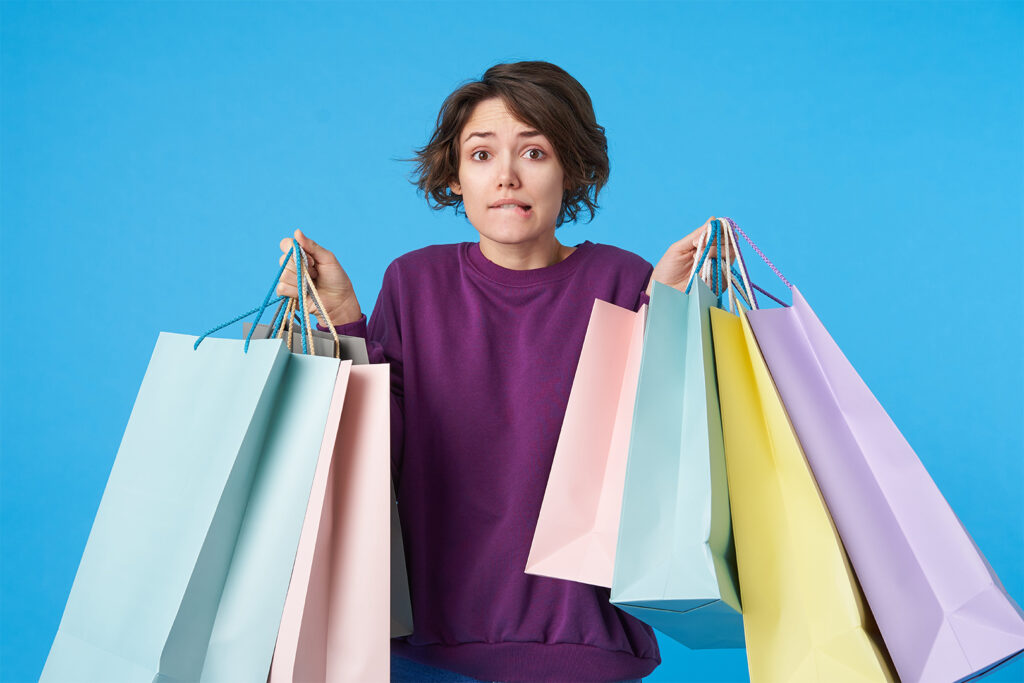
In one of my MBA classes, I was talking about decision making. A girl narrated incident where she was done shopping and she saw a girl trying a brown shade lipstick. She could not hold herself and ended up buying that lipstick. She has not used that lipstick ever since she bought that lipstick. She was wondering as to what pushed her towards the purchase.
The academic literature regarding the impulse purchases is rich and widely available. Most of the articles relate the behaviour to the contextual factors, product attributes or the store environment. In this article I would like to share the role of other factors in influencing the purchase.
We are quite aware now not most of the purchases that made are not conscious. Harvard Business School professor Gerald Zaltman says that 95 percent of our purchase decision making takes place in the subconscious mind. So next time when you show an impulsive behaviour, don’t feel bad, because it might be something that you could not have controlled so easily.
Before we look at the factors that can enhance the impulsive behaviour, let find our what is impulsive behaviour.
What is impulsive buying?
Consumer researchers have defined consumer impulsivity as experiencing a sudden and unplanned urge that is immediately gratifying or acting on an impulse without careful deliberation of the negative or long-term consequences. There are two elements which characterise an impulse buying. First is lack of planning and deliberation and second is presence of emotional response such as anger or joy.
What triggers impulse buying?
The academic literature regarding the impulse purchases is rich and widely available. Most of the articles relate the behaviour to the contextual factors, product attributes or the store environment, personality traits, education level etc. In this article I would like to share the role of other factors in influencing the purchase. Let us explore some more variables related to neuromarketing.
- Can the consumption of the food before the shopping make you an impulsive buyer? It has been found that the higher level of serotonin decreases the impulsive behaviour. For example, there are evidences to prove that coffee intake can reduce the level of serotonin over a period and hence raise the impulsive behaviour.
Also, people are likely to buy more when they are hungry than they are satiated.
- Can the action of other people influence you to make an impulsive decision? Ever heard of mirror neurons how it works? Neuroscientist Giacomo Rizzolatti, MD, with his colleagues at the University of Parma first identified mirror neurons. Mirror neurons are a type of brain cell that respond equally when we perform an action and when we witness someone else perform the same action.
In simple words we can describe it as ‘monkey see monkey do’. Mirror neurons act in tandem with dopamine, a pleasure hormone which makes us buy things. In the case of the girl buying the lipstick after looking at the other girl using, it might have activated the mirror neurons which in turn have released the dopamine. This activation might have urged her to buy that lipstick.
- Can the mental load make you more impulsive? Mental load or cognitive load refers to the amount of information that the working memory can hold at one time. There are several research which proves people become impulsive under the cognitive load. One of the notable experiments was when the respondents were asked to choose between healthy salad and a dessert, respondents under the cognitive load were more inclined to choose the unhealthy dessert rather than the salad. When attention is focused elsewhere, such as on retaining a long number, there is less of this resource available to guide the decision over snack choice. As a result, people lose their self-control and make less rational choices. If a customer receives a phone call while shopping, he may buy more than what he intends to.
Conclusion
To conclude as a customer one must go for shopping satiated to avoid the trap of impulse. They should also avoid food which decreases the serotonin level. Eating foods high in trans fats like potato chips, pizza, and fast food are linked to decreasing serotonin levels. On the other hand, the departmental store should open outlets providing these kinds of foods. Bhat-Bhateni has plenty of fast-food restaurants, around the store. Now you know why.
To avoid impulse purchases and make the choices rationally always shop with a list in your hands. Make sure to increase the pain of paying by paying in cash. Keep limited cash so that you do not go overboard with your shopping. Do not go for shopping after fighting with your spouse. That is when you are emotionally charged.
https://www.linkedin.com/pulse/i-see-buy-what-inside-you-triggers-impulse-buying-pushkar-sharma
Sengupta, Jaideep and Rongrong Zhou (2007), “Understanding Impulsive Eaters’ Choice Behaviors: The Motivational Influences of Regulatory Focus,” Journal of Marketing Research, 44 (May), 297–308.

0 Comments