

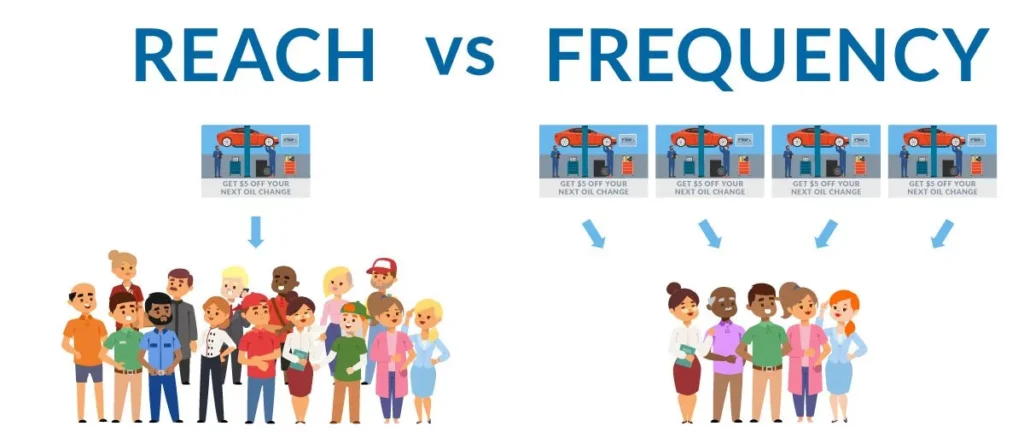
The Reach vs. Frequency Debate
The debate between reach and frequency has always been central to media planning. A few days ago, I posed a question on my social media:
If you have a budget of Rs. 1000, and it costs Rs. 1 to reach a customer, how would you allocate your budget?
- Reach 1,000 customers once
- Reach 500 customers twice
- Reach 200 customers five times
Unsurprisingly, most people responded that they would prefer reaching 500 customers twice or 200 customers five times. But what does research say?
What is Reach?
Reach, also known as coverage, is the percentage of your target audience that has been exposed to your advertisement at least once. Whether they actively notice it or not, they are still exposed.
What is Frequency?
Frequency refers to the number of times an individual sees your advertisement.
According to @Byron Sharp (2010), “frequency” can be understood in two ways:
Long-term coverage – frequency in the sense of coverage over time, so that consumers don’t forget about us, and so when they make a category purchase the gap since the last time, they saw one of our ads isn’t too long
Repetitive exposure in a short period – Showing the same ad multiple times within a short timeframe to reinforce the message.
Which one is more effective? We need the first type of frequency (long-term coverage), not the second. Advertising works differently from classroom learning. Good advertising works immediately; while repeating a bad advertisement multiple times is an inefficient use of the media budget.
What Does Research Say?
Studies dating back to John Philip Jones (1992) suggest that the sales response to advertising exposure follows a convex pattern—meaning that a single exposure is often enough to generate a response. Additional exposures have a diminishing effect, although they still contribute positively (Jones, 1992).

Two Key Insights:
- The market consists of more light buyers than heavy buyers. Growth depends on reaching light category buyers since they make up the majority.
- 95% of customers are not in the market at any given time for your product.
What Should You Do?
To grow your brand, reach as many light buyers as possible so that when they are ready to make a purchase, they remember you. Also, growth depends on light category buyers as they are more in number.
Imagine you got a haircut yesterday and won’t need another for 30 days. If a salon keeps showing you ads for five consecutive days and then stops, you will likely forget about them by the time you actually need a haircut. Spacing out ads ensures they stay in your memory when it matters.
This aligns with the 95% rule—most people aren’t in the market, so broader reach increases the chances of reaching the 5% who are. If you focus too narrowly on repeating ads to the same audience, you risk missing those who are actually ready to buy.
Key Takeaways
✅ The first exposure in a given period has the most impact; repeated exposures have diminishing returns.
✅ Ads should be spaced out over time to build strong memory structures rather than appearing in a short burst.
✅ Overloading audiences with repeated ads in a short time can lead to boredom and inattention.
✅ Advertising should work on the first impression rather than relying on repetition.
✅ Light and new category buyers should not be ignored—reach them regularly.
✅ Maximizing unduplicated reach should be a priority.
References
- Jones, J. P. (1992). How Much is Enough? Getting the Most from Your Advertising Dollar. Lexington Books.
- Taylor, J., Kennedy, R., & Sharp, B. (2009). Is once really enough? Making generalizations about advertising’s convex sales response function. Journal of Advertising Research, 49(2), 198-200.
- Reach maximalism: The case for an audience-first approach to B2B growth. LinkedIn. Retrieved from https://business.linkedin.com/marketing-solutions/b2b-institute/b2b-research/trends/reach-maximalism
- Sharp, B. (2010). How Brands Grow. Oxford University Press.
- Romaniuk, J. (2016). How Brands Grow: Part 2. Oxford University Press.
- Marketing Science – Frequency & Reach
- Radio Ink – Reach vs. Frequency ROI

0 Comments