

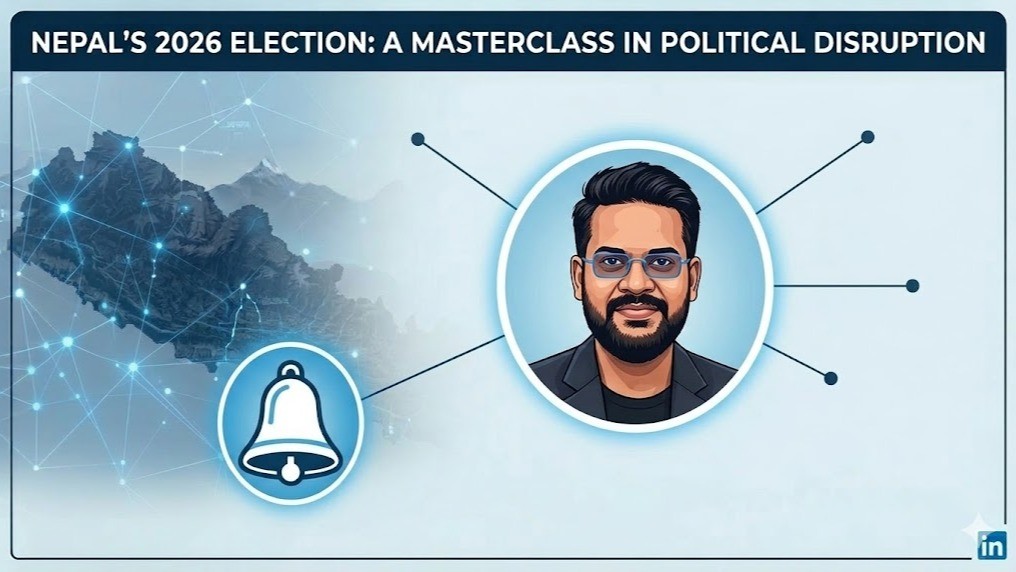
How does a party go from underdog to almost two-thirds majority in a 2082 election? Rashtriya Swatantra Party just did it and almost no one predicted it.
The parties that dominated Nepali politics for decades didn’t just lose. They almost collapsed.
So what exactly happened?
Let’s break down the RSP victory using few marketing principles.
1. The Balen Factor: Borrowing Equity
It won’t be an exaggeration to say that the party rallied on the shoulders of Balendra Shah. It was a master stroke by RSP to bring Balen into their camp. Proposing him as a Prime Ministerial candidate RSP essentially borrowed his brand equity.
Balen already had:
- Credibility
- Youth appeal
- A reputation for action
- Cross-regional acceptance
Most importantly his presence did two things:
a. Credibility Bridging: Even the voters who were sceptical about Rabi Lamichane gladly voted for the party. Lets not forget he was in jail for cooperative scam.
b. Market Expansion: He bridged the geographical divide (Madhesh and Pahad), essentially unifying two disparate consumer segments under one National Brand.
Basically it allowed voters to transfer trust to the party.
2. The Voter Phenomenon: Expanding the Market
Turnout remained moderate (around 60%), but the composition of voters shifted significantly toward younger voters. This shift showed up in the numbers too:
Since 2022:
- 915,119 new voters were added to the voter list.
- Many came from youth-led protest movements.
- Several irregular voters turned out this time simply to ensure change.
In the Proportional Representation (PR) system, RSP secured over 53% of early counted votes, indicating a massive “switcher” movement away from traditional parties.
This means RSP didn’t just compete for existing voters. They activated new ones.
They focused on penetration rather than loyalty.
3. Mental and Physical Availability
Successful brands are easy to mind and easy to find.
Mental availability
- simple messaging for change
- repeated exposure to the same symbols and personalities
This ensured that when voters entered the booth, the party was top-of-mind. The candidates were not important but the the bell and Balen were on their mind.
Physical Availability:
- candidates in most constituencies
- strong digital campaign presence
They ensured the brand was on the shelf in every constituency. Even without traditional ground troops (cadres), their digital omnipresence made them feel local everywhere.
4. Distinctive Assets
Most voters:
- do not read manifestos
- do not compare policies
They use mental shortcuts while making decisions
Distinctive symbols help voters make quick choices. The party’s symbol the Bell (Ghanti) was visually simple and memorable. It was consistently used in each campaign and even in slogans.
More importantly, the campaign repeatedly linked two recognizable cues:
- Balen
- Ghanti
This built strong mental shortcuts for voters.
5. Legacy Brand Decay
Every brand has a lifecycle. The Legacy Parties reached a point of Brand Decay.
Category Boredom: Voters were fatigued by the same faces offered for decades.
A common sentiment was: “Instead of being fooled by the same people repeatedly, why not give someone new a chance?”
6. Momentum and Social Proof
When people see momentum, they want to join the winning side. Social media created a perception that: “Everyone is voting for change.” Momentum creates a snowball effect. This explains why predictions often fail.
Conclusion
This is not the first time Nepal has seen a landslide political victory. For example, the 2008 Nepal Constituent Assembly Election also produced a dramatic shift in power. And we know how that eventually unfolded.
So as citizens, this is the moment to change our stance as well. Stop treating politicians like celebrities. Today’s enthusiastic supporter can easily become tomorrow’s Jholey. Only the party names change.

0 Comments